


How Computer Vision Development Services Improve Business Intelligence
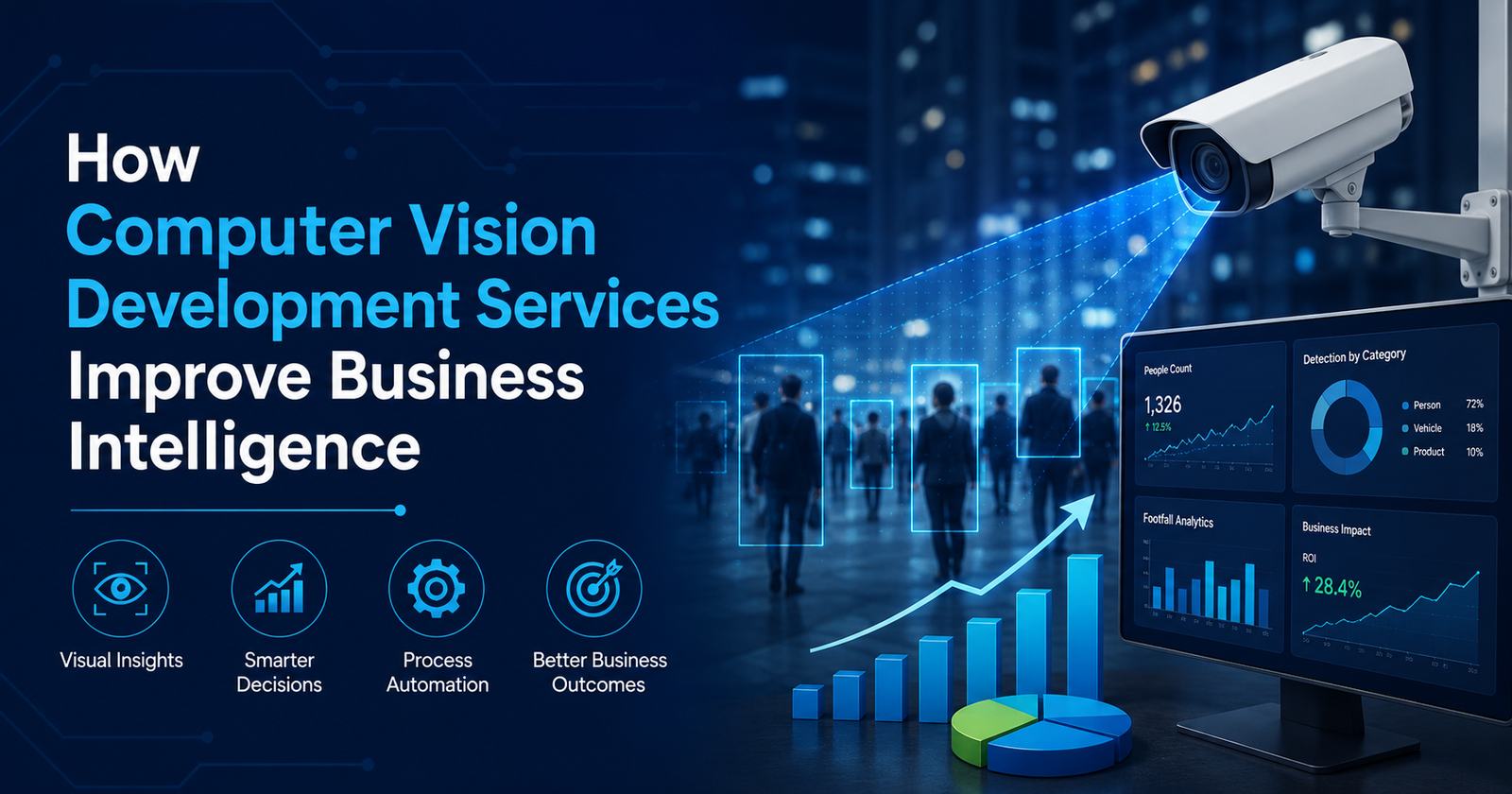
The way businesses collect, interpret, and act on data is undergoing a quiet revolution — and much of it is happening through the lens of a camera. Computer vision, once confined to research labs and science fiction narratives, is now embedded in warehouse floors, retail stores, manufacturing lines, and corporate boardrooms. What makes this technology genuinely transformative for business owners is not just its ability to "see" — it's its ability to understand visual data at a scale and speed that no human team can match. When you invest in computer vision development services, you're essentially giving your business a set of eyes that never blinks, never tires, and converts every visual input into actionable intelligence.
Business Intelligence (BI) has traditionally been driven by structured data — spreadsheets, CRM records, sales dashboards. But here's the limitation: a massive portion of the world's most valuable business data is unstructured and visual. Think about customer behavior on a shop floor, product defect patterns on a production line, or unauthorized access in a restricted zone. None of this gets captured in a spreadsheet. Computer vision bridges that gap, turning real-world visual events into structured data that feeds directly into your BI systems.
What Exactly Is Computer Vision in a Business Context?
Before diving into the impact on business intelligence, it's worth grounding the conversation. Computer vision is a branch of artificial intelligence that enables machines to interpret and make decisions based on visual inputs — images, video streams, real-time camera feeds, and even thermal or infrared data. It works by training deep learning models on large datasets so the system can recognize patterns, objects, anomalies, faces, movements, and much more with remarkable accuracy.
When you engage a computer vision development company, they typically build custom models tailored to your specific industry context — not generic, off-the-shelf tools that may only partially fit your workflows. The result is a system that understands your environment: your products, your people, your processes.
Key capabilities that drive BI outcomes include:
- Object detection and classification — identifying specific items, defects, or entities in real time within camera feeds
- Optical Character Recognition (OCR) — extracting text from labels, documents, invoices, and packaging automatically
- Pose and gesture estimation — analyzing human movement patterns for ergonomics, safety compliance, or customer interaction studies
- Scene understanding — interpreting the overall context of a visual environment, such as crowd density or facility layout
- Anomaly detection — flagging unusual patterns, deviations from standards, or out-of-range visual signals in production or security feeds
Turning Visual Data Into Strategic Business Intelligence
For business owners, the most important question is always: "What decisions will this help me make better?" The answer, when it comes to computer vision software development, spans every major function of a modern enterprise. Visual data collected from operations, customers, and assets gets transformed into dashboards, alerts, and trend reports that decision-makers can act on immediately or over time.
Consider inventory management — one of the most resource-intensive challenges for product-based businesses. Traditional inventory tracking depends on manual counting, barcode scanning, and periodic audits, all of which are time-consuming and error-prone. Computer vision systems installed in warehouses or stores can continuously monitor shelf levels, track item movement, and automatically trigger restocking alerts without a single manual input. This isn't just efficiency — it's intelligence, feeding live data into your supply chain BI layer and enabling just-in-time decisions that reduce both stockouts and overstock situations.
Here's how computer vision strengthens BI across specific business functions:
- Sales & Retail Analytics — foot traffic heatmaps, dwell time measurement, and purchase pattern analysis help optimize store layout and product placement
- Quality Control — automated visual inspection in manufacturing detects defects at a microscopic level, generating defect-rate data that feeds quality BI dashboards
- Workforce Productivity — anonymized movement and activity analysis helps identify workflow inefficiencies and bottlenecks on the factory or warehouse floor
- Customer Experience Monitoring — sentiment analysis through facial expression recognition (with consent) provides real-time feedback loops on customer satisfaction in service environments
- Asset & Equipment Monitoring — visual surveillance of machines detects wear, misalignment, or early failure symptoms, enabling predictive maintenance BI models
Why Off-the-Shelf Tools Fall Short — and Custom Development Wins
There is no shortage of pre-built computer vision tools in the market today. From cloud APIs to open-source models, businesses often try to patch together solutions using generic tools. The results are almost always underwhelming because generic models are trained on generic data. They do not know what a properly assembled unit looks like on your production line. They cannot distinguish between a routine employee movement and a safety violation in your specific facility layout. This is precisely why working with a computer vision software development company that builds custom solutions makes a strategic difference.
Custom development means the model is trained on your real-world data, integrated into your existing technology stack — ERP, CRM, BI platforms — and tuned to your operational thresholds. You get a system that grows more accurate over time as it continues learning from your environment, rather than one that delivers mediocre results because it was built for everyone and optimized for no one.
Key advantages of custom computer vision development:
- Domain-specific accuracy — models trained on your actual use case dramatically outperform generic pre-trained alternatives
- Seamless BI integration — outputs feed directly into existing dashboards (Power BI, Tableau, custom analytics platforms) without requiring data translation layers
- Scalable architecture — whether you're processing feeds from 5 cameras or 500, the infrastructure is designed to scale with your operations
- Regulatory compliance — custom builds can incorporate privacy controls, data anonymization, and audit trails required by industry-specific regulations
- Competitive differentiation — proprietary visual intelligence systems are difficult for competitors to replicate, creating lasting strategic advantage
The Role of Computer Vision Developers in Building Your BI Ecosystem
Behind every effective computer vision deployment is a team of skilled professionals who understand both the technology and your business domain. Computer vision developers bring expertise in deep learning frameworks (TensorFlow, PyTorch), image processing pipelines, edge computing, and cloud infrastructure — but the best ones also understand how to translate business requirements into model architectures that deliver measurable outcomes.
When selecting a development partner, business owners should look beyond technical credentials alone. The right computer vision developers ask smart questions about your data environment, your BI goals, your operational constraints, and your compliance requirements before writing a single line of code. They think in terms of ROI, not just model accuracy. They design systems that operations teams can actually use and maintain, not black boxes that require a PhD to interpret.
What a strong development engagement typically covers:
- Discovery and requirements mapping — understanding your business process, data sources, and BI integration points
- Data collection and annotation — gathering and labeling visual training data representative of your real-world scenarios
- Model development and validation — building, testing, and iterating on computer vision models against business-defined success metrics
- Edge vs. cloud deployment decisions — determining where processing happens based on latency, bandwidth, and cost requirements
- BI dashboard integration — connecting model outputs to your analytics and reporting layer so decision-makers see insights, not raw model outputs
- Monitoring and retraining pipelines — ensuring models remain accurate over time as your environment evolves
Industry-Specific Applications That Are Reshaping BI
The versatility of computer vision means its BI impact shows up differently depending on the industry. Business owners in manufacturing, retail, healthcare, logistics, and real estate are all finding unique applications that fundamentally change how they understand their operations.
In manufacturing, computer vision software development has made inline quality inspection not just feasible but cost-effective at scale. Systems inspect thousands of units per hour with defect detection rates that exceed human inspectors, while simultaneously logging defect types, locations, and frequencies into BI systems for process improvement analysis. In retail, planogram compliance monitoring automatically verifies that products are placed correctly on shelves across hundreds of store locations, eliminating the need for costly manual audits while generating compliance rate data that ties directly to sales performance analysis. In logistics and warehousing, computer vision tracks package handling, monitors loading dock activity, and verifies shipment contents, feeding data into supply chain BI dashboards in real time. In healthcare facilities, visual monitoring supports patient safety protocols, staff workflow optimization, and equipment utilization tracking — all with privacy protections baked into the architecture.
Measuring ROI: What Business Owners Should Expect
Investing in computer vision development services is a strategic capital decision, and like any strategic investment, it deserves a clear ROI framework. The good news is that computer vision BI improvements tend to show up in measurable, financial terms relatively quickly — often within the first year of deployment.
The clearest ROI drivers to track include:
- Reduction in quality-related costs — defect detection systems typically reduce rework and warranty claims by measurable percentages within months of deployment
- Labor reallocation value — tasks that previously required dedicated human oversight (counting, inspecting, monitoring) can be reallocated to higher-value activities
- Inventory optimization savings — real-time shelf and stock intelligence reduces both excess inventory carrying costs and lost revenue from stockouts
- Incident reduction — safety monitoring systems reduce workplace accidents, translating directly into reduced insurance costs and liability exposure
- Decision speed improvement — BI dashboards powered by real-time visual data enable faster operational decisions, reducing the cost of delays and missed windows
Choosing the Right Computer Vision Partner
Not every technology vendor has the depth to deliver enterprise-grade computer vision BI systems. When evaluating a computer vision development company, go beyond the demo. Ask to see real deployment case studies in environments similar to yours. Inquire about data security practices, model maintenance commitments, and post-deployment support structures. Understand how they handle model drift — the gradual degradation in accuracy that happens as real-world conditions evolve — because a system that works brilliantly at launch but degrades silently over 18 months is not truly enterprise-ready.
The right partner doesn't just build you a model — they build you a capability. One that your team understands, trusts, and uses to make better decisions every single day.
Final Thoughts
Business intelligence has always been about reducing uncertainty and improving the quality of decisions. Computer vision extends that mission into the physical, visual world — the world where most of your business actually happens. Whether it's a production line, a retail floor, a logistics hub, or a service environment, the insights locked in visual data are enormous, and they have been largely inaccessible until now.
Partnering with experienced computer vision developers and investing in purpose-built computer vision software development is no longer a futuristic ambition — it's a competitive necessity for businesses that want to lead in their category. The companies that understand this today are building BI capabilities their competitors will spend years trying to catch up to.
The question isn't whether your business generates visual data worth analyzing. It does. The question is whether you're capturing it — or leaving it behind.

 Arabic
 French
 Spanish
 Portuguese
 Deutsch
 Turkish
 Dutch
Dutch
 Italiano
 Russian
 Romaian
 Portuguese (Brazil)
 Greek
Greek