


What services does a Modular Ophthalmic OT Setup Company provide?
INTRODUCTION
A professional Modular Ophthalmic OT Setup Company provides much more than modular room construction. Its services can cover the complete development of an ophthalmic operation theatre, from initial site assessment and customized planning to modular installation, HVAC integration, HEPA filtration, medical gases, electrical systems, equipment coordination, testing, commissioning, documentation, and maintenance support. Because ophthalmic surgery requires a controlled and well-organized clinical environment, every engineering component must work together to support surgical workflow, environmental control, hygiene, and operational reliability.
Unlike conventional construction services, specialized ophthalmic OT setup services combine healthcare planning with cleanroom engineering and building-services integration. The exact scope varies by project, but a comprehensive provider can offer a coordinated solution from concept to handover.
What Is a Modular Ophthalmic Operation Theatre?
A modular ophthalmic operation theatre is a specialized surgical environment constructed using engineered modular components and integrated healthcare systems.
A typical project may include:
- Modular wall and ceiling systems
- Hygienic flooring
- Sealed doors
- HVAC systems
- HEPA filtration
- Controlled airflow
- Medical gas systems
- Electrical infrastructure
- Surgical lighting
- Environmental monitoring
- Equipment integration
- Testing and commissioning
The design should be customized according to the hospital's available space, surgical procedures, equipment, workflow, and technical requirements.
1. Site Survey and Project Assessment
The first service generally involves understanding the existing facility.
A site assessment can examine:
- Room dimensions
- Ceiling height
- Existing HVAC infrastructure
- Electrical capacity
- Medical gas availability
- Plumbing
- Structural conditions
- Access routes
- Equipment movement paths
- Existing hospital operations
A detailed assessment helps identify limitations before design and installation begin.
2. Consultation and Requirement Analysis
A professional setup company works with hospital administrators, surgeons, architects, biomedical teams, and facility managers to understand project requirements.
The consultation may cover:
- Type of ophthalmic procedures
- Number of operating rooms
- Equipment requirements
- Patient workflow
- Staff workflow
- Storage requirements
- Environmental-control objectives
- Future expansion
This information forms the basis for the OT design.
3. Customized OT Layout Design
Every ophthalmic facility has different requirements.
A specialized provider can develop customized layouts covering:
- Operating table placement
- Surgical microscope location
- Surgical light positioning
- Equipment placement
- Staff movement
- Patient entry and exit
- Storage
- Utility locations
- Service access
Effective space planning can improve workflow and reduce unnecessary movement.
4. Modular Wall and Ceiling Installation
One of the primary services is the installation of modular wall and ceiling systems.
These systems can provide:
- Smooth surfaces
- Sealed joints
- Easy cleaning
- Durable construction
- Service integration
- Controlled-room interfaces
Material selection should be based on the project's clinical, environmental, cleaning, and maintenance requirements.
5. Hygienic Flooring Solutions
Flooring is an important part of OT construction.
The selected flooring should support:
- Routine cleaning
- Resistance to wear
- Hygienic operation
- Seam or joint management
- Long-term durability
Depending on the project, specialized resilient or conductive flooring systems may be considered.
6. Hermetically Sealed Door Installation
Doors are an important part of maintaining controlled room conditions.
A professional provider may supply and install:
- Hermetically sealed doors
- Sliding doors
- Hinged doors
- Viewing panels
- Door closers
- Interlocking systems where required
Door specifications should correspond with the airflow and room-control strategy.
7. HVAC Engineering and Installation
HVAC is one of the most important technical services in a modular ophthalmic OT project.
HVAC planning can address:
- Temperature control
- Humidity management
- Fresh-air supply
- Air changes
- Filtration
- Air distribution
- Pressure relationships
The system should be engineered according to the project's environmental requirements rather than treated as ordinary room air conditioning.
8. HEPA Filtration Integration
High-efficiency filtration may form part of the OT's environmental-control system.
A setup provider may supply and install:
- HEPA filter modules
- Filter housings
- Sealing systems
- Filter access arrangements
- Differential pressure monitoring
HEPA filter integrity and installation quality are important considerations during commissioning.
9. Laminar or Unidirectional Airflow Systems
Where specified by the project, a provider may design and install laminar or unidirectional airflow systems.
These systems can involve:
- Airflow modules
- HEPA filters
- Blowers or AHUs
- Ductwork
- Air distribution terminals
- Control systems
- Monitoring equipment
The airflow strategy should be selected according to the surgical environment and applicable project requirements.
10. Medical Gas Installation
Ophthalmic OTs may require medical gas services depending on clinical requirements.
Potential systems include:
- Oxygen
- Medical air
- Vacuum
Services may include planning outlet locations, pipeline integration, terminal installation, testing, and documentation.
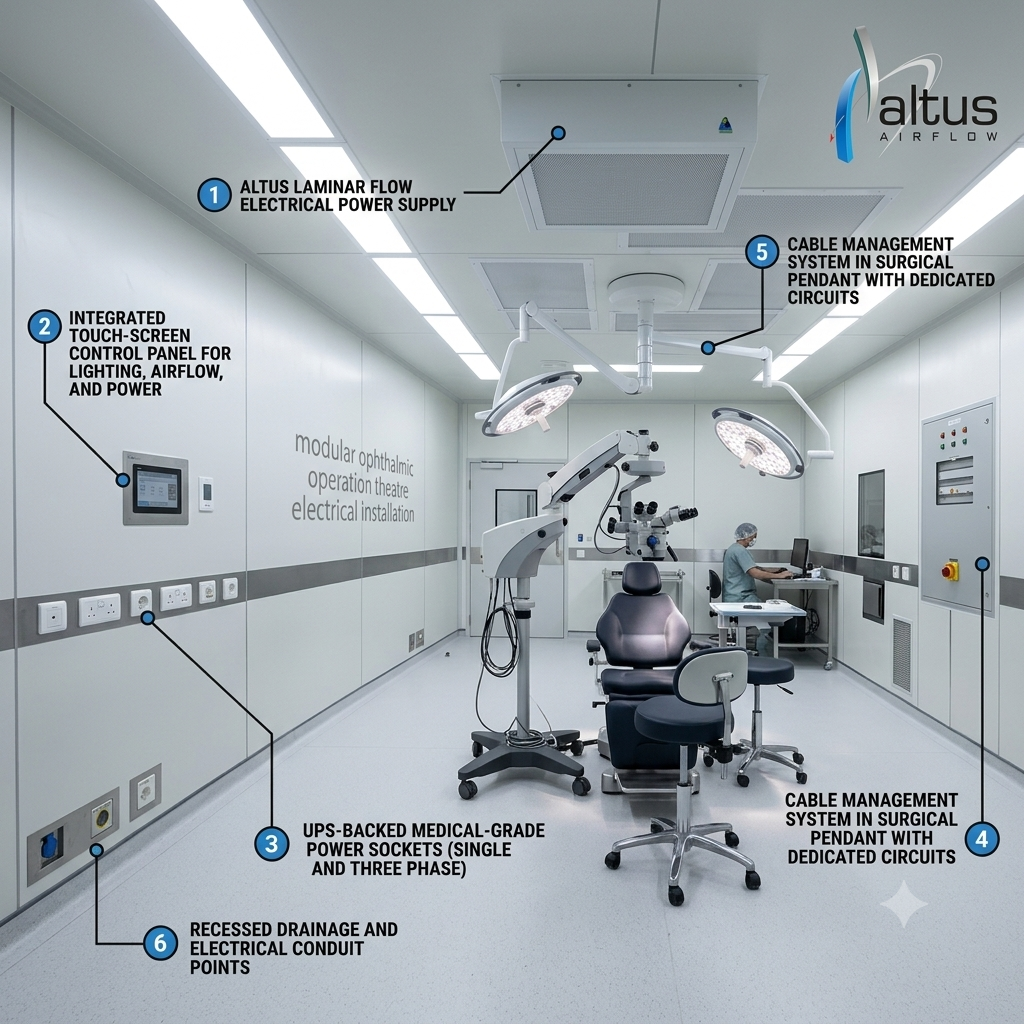
11. Electrical System Integration
Modern ophthalmic OTs contain sensitive medical and surgical equipment.
Electrical services can include:
- Dedicated equipment outlets
- Emergency power
- UPS connections
- Earthing
- Control circuits
- Data connections
- Electrical distribution
Electrical planning should consider the actual equipment schedule and facility infrastructure.
12. Surgical Lighting Installation
Proper lighting is essential for ophthalmic procedures.
A setup company may coordinate installation of:
- Surgical lights
- Examination lights
- General LED lighting
- Task lighting
- Control systems
Lighting placement should be coordinated with operating tables, microscopes, ceiling systems, and other equipment.
13. Ophthalmic Equipment Coordination
A professional setup company can coordinate the room around specialized ophthalmic equipment.
Equipment may include:
- Operating microscopes
- Phacoemulsification systems
- Vitrectomy systems
- Surgical tables
- Patient monitors
- Visualization systems
- Surgical lights
The design should account for equipment dimensions, power requirements, service access, and movement.
14. Environmental Monitoring
Environmental monitoring can help facility teams track important operating conditions.
Depending on project requirements, monitoring may include:
- Temperature
- Relative humidity
- Differential pressure
- Airflow
- Air quality
- Filter condition
Digital monitoring systems may also provide alarms when defined parameters move outside acceptable limits.
15. Cleanroom Engineering
A specialized provider can incorporate cleanroom principles into OT planning.
Services may address:
- Airflow management
- Pressure relationships
- Filtration
- Hygienic surfaces
- Room zoning
- Contamination-control strategies
- Cleaning considerations
The objective is to create a controlled environment appropriate to the facility's clinical requirements.
16. Equipment and Utility Planning
Equipment should be considered before construction begins.
The setup company can coordinate:
- Electrical points
- Medical gas outlets
- Data points
- Structural supports
- Ceiling services
- HVAC requirements
- Equipment clearances
Early coordination can prevent expensive modifications after installation.
17. Procurement and Material Supply
Depending on the contract, turnkey services may include procurement of project materials and equipment.
This can cover:
- Modular panels
- Doors
- Flooring
- HVAC components
- HEPA filters
- Electrical components
- Medical gas components
- Monitoring systems
- Accessories
Procurement should follow approved technical specifications and project schedules.
18. Project Management
A complete OT project can involve several engineering disciplines.
Project management services may include:
- Schedule preparation
- Vendor coordination
- Material planning
- Site supervision
- Quality inspections
- Progress reporting
- Installation coordination
A dedicated project manager can provide a central point of communication for the hospital.
19. Installation and Site Execution
Installation can include all major modular and engineering systems.
Activities may involve:
- Site preparation
- Modular panel installation
- Ceiling installation
- Flooring
- Door installation
- HVAC installation
- Filtration installation
- Electrical work
- Medical gas installation
- Monitoring integration
- Equipment coordination
Proper sequencing helps prevent conflicts between different trades.
20. Testing and Commissioning
A professional project should include testing before handover.
Depending on the technical specification, testing can include:
- Airflow measurements
- HEPA filter integrity testing
- Particle measurements
- Pressure differential testing
- Temperature verification
- Humidity verification
- HVAC performance testing
- Electrical testing
- Medical gas testing
Commissioning confirms that the installed systems operate according to defined acceptance criteria.
21. Validation and Performance Verification
Validation and qualification requirements vary according to the project and applicable standards.
Performance verification may include:
- Environmental measurements
- Airflow verification
- Filtration checks
- Pressure testing
- Equipment functionality
- Monitoring-system verification
Test results should be documented for facility records.
22. Documentation and Handover
A complete setup service should provide appropriate project documentation.
This may include:
- Approved drawings
- As-built drawings
- Equipment manuals
- Test reports
- Commissioning records
- Filter documentation
- Warranty information
- Maintenance instructions
Complete documentation helps facility teams manage the OT after handover.
23. Preventive Maintenance Services
OT infrastructure requires regular maintenance.
A provider may offer:
- HVAC servicing
- HEPA filter inspection
- Filter replacement
- Airflow balancing
- Sensor calibration
- Electrical inspection
- Door maintenance
- Environmental monitoring
Preventive maintenance can help maintain consistent system performance.
24. After-Sales Technical Support
After installation, hospitals may require technical assistance.
Support can include:
- Troubleshooting
- Spare parts
- System inspections
- Equipment servicing
- Filter replacement
- HVAC support
- Control-system assistance
Reliable support can reduce downtime and simplify facility management.
25. Future Expansion Planning
Hospitals often expand surgical capacity or introduce new technology.
A modular OT can be planned for:
- Additional equipment
- Technology upgrades
- Utility modifications
- Monitoring improvements
- HVAC upgrades
- Future renovation
Considering expansion during the initial design can reduce disruption later.
26. Benefits of Using an Integrated Setup Company
A comprehensive provider can offer several advantages.
Single-Point Coordination
The hospital can work with one project partner for multiple engineering requirements.
Better System Integration
HVAC, filtration, electrical, medical gases, modular construction, and equipment can be coordinated.
Improved Workflow
Equipment and room layout can be planned around actual surgical processes.
Better Quality Control
Installation and engineering systems can be inspected as part of one coordinated project.
Simplified Commissioning
Testing and documentation can be organized under a unified project structure.
Easier Maintenance
Service requirements can be considered during design and installation.
How to Choose the Right Setup Company
Hospitals should evaluate potential providers based on:
- Ophthalmic OT experience
- Healthcare project portfolio
- Modular construction expertise
- HVAC engineering capability
- HEPA filtration knowledge
- Medical gas expertise
- Electrical integration
- Equipment coordination
- Testing and commissioning
- Documentation
- Maintenance support
- Project management
It is also useful to request detailed technical specifications and references for comparable projects.
What Should Be Included in the Project Scope?
Before signing a contract, healthcare facilities should clarify whether the quotation includes:
- Design
- Engineering
- Material supply
- Installation
- HVAC
- Filtration
- Electrical systems
- Medical gases
- Equipment integration
- Testing
- Commissioning
- Documentation
- Warranty
- Maintenance
Clearly defining the scope helps prevent misunderstandings and unexpected costs.
Conclusion
A professional Modular Ophthalmic OT Setup Company can provide a comprehensive range of services, including site assessment, customized OT design, modular wall and ceiling installation, hygienic flooring, sealed doors, HVAC engineering, HEPA filtration, laminar or controlled airflow, medical gas integration, electrical systems, surgical lighting, equipment coordination, environmental monitoring, testing, commissioning, documentation, maintenance, and after-sales support. The most effective approach is to coordinate these systems from the beginning so that the final operation theatre supports surgical workflow, environmental control, maintainability, and future expansion. For hospitals and eye-care centers seeking integrated ophthalmic OT planning, engineering, installation, and commissioning, Altus Airflow provides specialized solutions focused on dependable and efficient healthcare environments.
Frequently Asked Questions
1. What services does a Modular Ophthalmic OT Setup Company provide?
A professional Modular Ophthalmic OT Setup Company may provide site assessment, OT design, modular construction, HVAC, HEPA filtration, controlled airflow, electrical systems, medical gases, equipment coordination, testing, commissioning, documentation, and maintenance support.
2. Does a Modular Ophthalmic OT Setup Company provide customized OT designs?
Yes. A Modular Ophthalmic OT Setup Company can customize the OT layout according to available space, surgical procedures, equipment, workflow, utilities, and future expansion requirements.
3. Does a Modular Ophthalmic OT Setup Company install HVAC systems?
Yes. Depending on the project scope, a Modular Ophthalmic OT Setup Company can design, supply, install, and commission HVAC systems for temperature, humidity, filtration, airflow, and pressure management.
4. Is HEPA filtration included in ophthalmic OT setup services?
HEPA filtration can be included as part of the environmental-control system. A professional Modular Ophthalmic OT Setup Company can coordinate HEPA filter selection, installation, sealing, monitoring, and integrity testing.
5. Does a Modular Ophthalmic OT Setup Company provide medical gas installation?
Depending on the project scope, a Modular Ophthalmic OT Setup Company can coordinate oxygen, medical air, vacuum, pipeline connections, terminal outlets, testing, and documentation.
Read Our Previous Blog------>What equipment is supplied and installed by a Laminar Airflow System Setup Company?
 Spanish
 English
 Arabic
 French
 Portuguese
 Deutsch
 Turkish
 Dutch
Dutch
 Italiano
 Russian
 Romaian
 Portuguese (Brazil)
 Greek
Greek